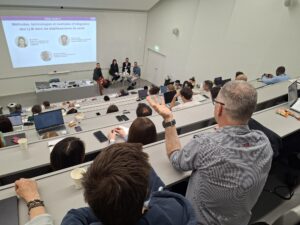
On June 4, 2026, Unys’ Digital Health Community brought together around one hundred participants at IAE Nancy School of Management on the ARTEM campus for its fourth networking event. This year’s edition focused on the use of Generative AI in healthcare organisations, with a particular emphasis on Large Language Models (LLMs).
LLMs are AI models capable of analysing, generating and structuring text from vast amounts of data. In healthcare, they are opening up new opportunities to support healthcare professionals, enhance training, analyse clinical documentation and improve the organisation of care pathways.
Co-organised by the AI Grand Est ENACT cluster and CHRU de Nancy (Nancy University Hospital), the event opened with welcoming remarks from Nicolas Fressengeas, Vice-President for Digital Affairs, Data and Open Science at Université de Lorraine, and Jean-Christophe Calvo, Head of the Territorial Department for Digital Transformation and Biomedical Engineering at CHRU de Nancy.
Setting the scene: opportunities and current limitations
Claire Gardent, CNRS Senior Research Scientist at LORIA and holder of an ENACT Research Chair, opened the programme with a keynote on the architecture of Large Language Models and their potential applications in healthcare.
Her presentation also highlighted the limitations that must be considered in clinical settings, including hallucinations that remain difficult to detect, response times that may be incompatible with certain emergency situations, algorithmic bias, data confidentiality and GDPR compliance.
These considerations framed the discussions throughout the day: integrating LLMs into healthcare organisations requires rigorous methods, careful evaluation, and close attention to technical, regulatory, ethical and organisational challenges.
Ethics, sustainability and regulation: key issues to address from the outset
The first panel discussion explored the ethical and environmental challenges associated with LLMs. It brought together Christophe Cerisara (CNRS, LORIA, Deputy Coordinator of the AI Grand Est ENACT cluster); Maria Fartunova (Université de Lorraine, IRENEE, holder of the Jean Monnet Chair “EUBioethics”); Nathalie Thilly (CHRU de Nancy, Head of the CRID); and Nicolas Girerd (CHRU de Nancy, Director of the Clinical Investigation Center).
The discussion focused on the conditions required for deploying these technologies in highly regulated healthcare environments, including data quality, accountability, algorithmic bias, regulatory compliance, environmental impact and user acceptance.
Real-world perspectives from pharmacy, medical imaging and data sharing
The second panel focused on implementation strategies and practical feedback, with contributions from Nora Bezaz (Université de Lorraine, CEREFIGE); Pedro Teixeira (CHRU de Nancy, Head of the Medical Imaging Department); and Grégory Rondelot (CHRU Metz-Thionville, Chief Hospital Pharmacist and Head of Department).
Speakers discussed the human, organisational, technical and clinical challenges involved in integrating new AI tools into routine healthcare practice. Bringing together academic, clinical and operational perspectives, the session explored what is already working, what challenges remain, and what can be built for the future.
Towards the end of the morning, Alexis Frisson, Partnership Development Officer at the AI Grand Est ENACT cluster, presented the cluster’s strategy for developing academic and industrial partnerships. Alexis Steiner, AI Coordinator at CHRU de Nancy, then outlined the hospital’s AI strategy.
Research projects showcased in the afternoon
The afternoon session featured ongoing research projects and experience reports presented by academic and non-academic members of the Digital Health Community.
The SAMU VOICE project, led by Vincent P. Martin (Inria – LORIA), is developing a speech analysis tool designed to support the detection of myocardial infarction in emergency situations.
Tom Bourgeade (Université de Lorraine – LORIA) presented a virtual patient powered by LLMs, designed to help medical students prepare for Objective Structured Clinical Examinations (OSCEs).
Camille Lavigne, a student at Université de Lorraine, introduced CAPSULE, a project that uses image analysis to identify solid medications in collaboration with the Nancy Poison Control Centre, CHRU de Nancy and LORIA.
Gabriela Hossu (CHRU de Nancy) presented ClinRad, a project exploring AI-assisted evaluation of preliminary radiology reports produced by radiology residents.
The RHU I-DEAL project, led by Bénédicte Caron, Professor of Medicine and Hospital Practitioner in Gastroenterology at CHRU de Nancy, focuses on remote patient monitoring and precision imaging for the early management of Crohn’s disease. The project is carried out in partnership with the start-up ALIAE, represented by Philippe Jolivet, and Docaposte, represented by Kyle Greely.
Jean-Dominique Journet, President of the French National Federation for People with Aphasia, also joined the event remotely to discuss the challenges and opportunities of AI for people living with aphasia.
Several non-academic members of the Digital Health Community also introduced their organisations, including Sébastien Plenat for the competitiveness cluster BioValley France, Charles Bleusez for ANAP (the French National Agency for Healthcare and Medico-social Performance), and Wassim Hamidouche for Microsoft’s AI for Good Lab Foundation.
By bringing together scientific, clinical, technological and partnership perspectives, this fourth Digital Health Community Day highlighted both the opportunities and the challenges associated with the growing adoption of Generative AI in healthcare.
The original version of this text was published in French on the Factuel website.
Read the original article