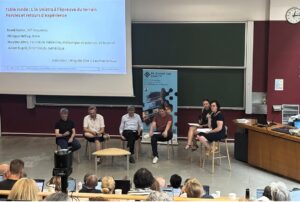
The study day “AI at the University of Strasbourg: Benchmarks, Uses and Perspectives” took place on 8 July at the University of Strasbourg. It brought together more than 400 members of staff to discuss the key challenges raised by the rapid development of artificial intelligence, while also providing hands-on opportunities to explore its applications through practical workshops. We spoke with Virginie Zint, Vice-President for Digital Affairs and Organisational Simplification at the University of Strasbourg.
How does the University of Strasbourg position itself regarding the use of AI by its staff?
We cannot pretend AI does not exist. The University of Strasbourg’s position is neither one of blanket prohibition nor of uncritical adoption. Writing support, document summarisation, translation, idea generation, transcription… AI can be valuable in certain situations and offers genuine added value, particularly for digital accessibility. However, it is not a substitute for professional expertise. It does not replace either human judgement or responsibility. Given its environmental impact, it is important to consider whether AI is genuinely useful, whether it delivers meaningful time savings, and to choose the most resource-efficient solution. In some cases, better organisation or a search engine may be all that is needed. Furthermore, whenever AI use has a collective impact at the level of a department, faculty or administrative process, it should be properly governed, documented and evaluated.
What about students?
Academic misconduct during examinations is a genuine concern, but it cannot be addressed solely through monitoring or sanctions. Expectations need to be clearly defined. In some cases, the use of AI may be prohibited, while in others it may be permitted, provided that its use is declared and critically assessed. Universities have a responsibility to equip students and staff with the knowledge required to understand the tools they use and to recognise their limitations.
What precautions should be taken when using AI?
Personal, human resources, health or unpublished research data, internal documents, confidential or strategic information… If information cannot be made public, it should not be shared with an uncontrolled external AI tool. Generative AI models can produce errors, fabricate references, reproduce stereotypes or overlook certain groups. These risks must be taken into account, and outputs should always be verified. Finally, to uphold scientific and academic integrity, particular attention should be paid to traceability, source citation, methodological transparency and respect for intellectual property. In some contexts, it may also be necessary to disclose whether an AI tool has been used, and to what extent.
The full version of the article is available in French, on the Savoir(s) website.
Read the original article