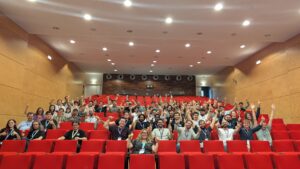
From July 6 to 10, the Inria Center at Université de Lorraine hosted the international AI for Human–Robot Interaction Summer School, organized by the Hucebot project team and led by Serena Ivaldi, Inria Research Director. Over five days, researchers, PhD candidates and students from around the world came together to explore the latest advances in artificial intelligence for robotics while fostering scientific exchange and discussion.
A scientific program addressing today’s key challenges in robotics
Throughout the week, participants attended around fifteen lectures delivered by leading international experts in artificial intelligence, robotics and the cognitive sciences.
The program covered a broad range of topics, including Large Language Models, Vision-Language Models, reinforcement learning, social robotics, embedded AI, Physical AI and AI ethics.
The human dimension of these technologies was also a central focus. Several lectures explored issues related to ethics, safety and trust in AI systems, as well as the contributions of the social sciences and humanities to the development of robots capable of interacting with people in a responsible and trustworthy manner.
The full article is available on the Inria website.
Read the original article (in French)This event was organized by the Hucebot project team (Inria, Loria (CNRS, UL)), with support from Inria, the euROBIN European project, the PEPR O2R – France 2030 program, the AI Grand Est ENACT Cluster, Université de Lorraine (ORION program), Loria, Google DeepMind and Bleu Robotics.