
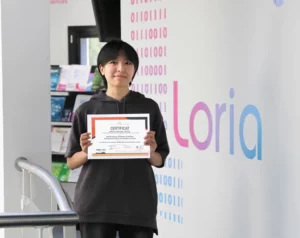
Estelle Zheng, a PhD candidate in the MosAIk team at Loria, supervised by Christophe Cerisara, Deputy Scientific Coordinator of the Grand Est AI cluster ENACT, has received the Best Paper Award at the CORIA-TALN 2026 conference. The award recognizes her paper entitled “Ladder Up, Memory Down : Low-Cost Fine-Tuning of LLMs With Side Nets”. She received the award on Thursday, July 2, 2026, at the conference, held this year in Nantes.
After completing a dual Bachelor’s degree in Science & Chinese (Electronic and Automatic Engineering, and Mandarin and Chinese Civilization), followed by a Master’s degree in Applied Mathematics and Data Science, Estelle Zheng began a CIFRE PhD at Loria (the Lorraine Laboratory for Research in Computer Science and its Applications).
“I am pursuing a CIFRE PhD, which means that I am conducting my doctoral research in partnership with a company that funds my thesis in order to address one of its specific challenges. In my case, the research topic is highly applied. I enjoy having one foot in academia and the other in the corporate world. At Alcatel-Lucent Enterprise, I am carrying out my PhD research on “Fine-Tuning Large Language Models, Planning and Action via APIs”. One of the key challenges is to fine-tune models in-house without necessarily requiring access to high-performance GPUs.”
This research addresses a key industrial challenge: making large language model (LLM) fine-tuning accessible without requiring high-end GPUs. LLMs, AI models trained on vast amounts of textual data, need to be specialized to meet specific use cases. However, conventional methods such as LoRA (Low-Rank Adaptation) can require substantial amounts of computational memory…
“General-purpose LLMs need to be fine-tuned to adapt them to specific applications. My research focuses on finding ways to specialize these models while keeping memory requirements low, making fine-tuning more affordable and accessible.”
Estelle Zheng is exploring a lighter alternative known as “Ladder”, which could significantly reduce memory consumption while maintaining comparable performance. Her research aims to determine whether this approach can provide a viable balance between efficiency and accessibility, particularly when using consumer-grade GPUs (graphics processing units).
In the longer term, her research could help democratize LLM fine-tuning by making it accessible to a broader range of users, including organizations with limited memory resources.
Read the full article on the Loria laboratory website
Text and photo credits: Loria Communications Department